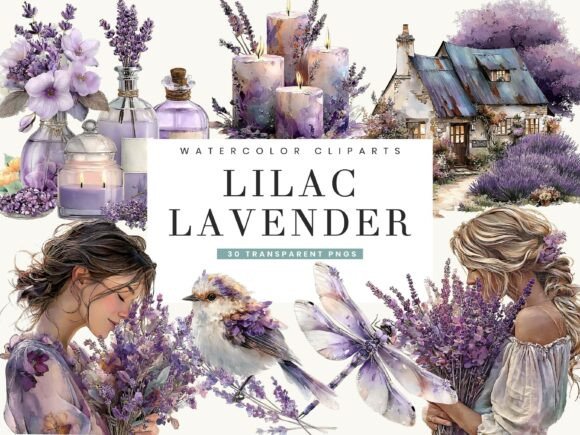
Integrating Watercolor Lilac Lavender Clipart into Your Creative Workflow
In the realm of digital design and print production, the choice of visual assets often dictates the emotional tone of a project. For creators aiming to evoke serenity, elegance, and natural beauty, Watercolor Lilac Lavender Clipart serves as a foundational element rather than a mere decorative afterthought. This specific aesthetic—characterized by soft pastel tones, organic brushstrokes, and delicate floral structures—requires a strategic approach to implementation. Understanding how to integrate these assets effectively can streamline your design process, ensuring consistency across invitations, planners, social media graphics, and commercial products.
The value of a curated bundle, such as a collection featuring 30 unique watercolor illustrations, lies in its versatility and technical readiness. When you incorporate high-resolution, transparent PNGs into your workflow, you eliminate the time-consuming steps of background removal and color correction. This allows you to focus on composition and hierarchy, moving quickly from concept to final output. Whether you are a freelance designer managing multiple client deadlines or a small business owner creating cohesive branding materials, mastering the use of these floral elements enhances both efficiency and visual impact.
Preparation and Asset Organization
Before diving into design software, proper organization of your digital assets is crucial for maintaining a smooth workflow. A typical Watercolor Lilac Lavender Clipart bundle includes files in PNG format with transparent backgrounds, usually at 300 DPI. This resolution is critical because it ensures that images remain crisp and detailed when printed on physical media, such as wedding invitations or sticker sheets, while still being lightweight enough for digital use.
Start by creating a dedicated folder structure on your drive or cloud storage. Categorize the clipart by type—for instance, separate full bouquets from individual sprigs or single blooms. This segmentation allows for quicker retrieval during the design phase. If you are working on a large-scale project, such as a planner series or a junk journal kit, having immediate access to specific elements prevents context switching and keeps your creative momentum intact. Additionally, verify the color profiles of your files. While most web-based designs utilize RGB, print projects require CMYK compatibility. High-quality watercolor assets are often created with neutral undertones that translate well across both spectrums, but a quick check ensures your lilac hues remain true to their intended softness.
Strategic Implementation in Design Projects
The application of watercolor florals varies significantly depending on the medium and the intended audience. Here is how you can strategically deploy these assets across different stages of your creative projects.
Print Media and Event Stationery
For wedding invitations, baby showers, and formal event stationery, the placement of Watercolor Lilac Lavender Clipart should enhance readability rather than compete with text. Use larger, more detailed bouquet illustrations as corner anchors or border elements. The transparent background feature is particularly useful here, allowing you to layer flowers over textured paper backgrounds without creating harsh white boxes. When designing for print, always preview your layout at 100% zoom to check for pixelation. The 300 DPI standard included in professional bundles ensures that the delicate gradients of the watercolor effect remain smooth, preserving the hand-painted illusion that adds perceived value to physical products.
Digital Products and Planners
In the creation of digital planners, stickers, and printable journals, scalability and modularity are key. Individual lavender sprigs and small clusters can be used as bullet points, section dividers, or decorative accents around headers. Because these elements are vector-like in their clarity (despite being raster images), they scale well for tablet screens and e-readers. When building a digital planner template, consider creating a "master slide" or template layer where your most frequently used clipart elements are pre-positioned. This reduces repetitive tasks and ensures a consistent visual language throughout the document. Users appreciate the calming effect of pastel florals in productivity tools, as it reduces visual fatigue and creates a more inviting interface for daily planning.
Social Media and Branding
Consistency in branding relies on the repeated use of specific visual motifs. Incorporating lilac and lavender florals into your social media templates establishes a recognizable aesthetic. Use smaller, simpler elements for Instagram stories or Pinterest pins where screen real estate is limited. The soft purple tones align well with brands focused on wellness, beauty, mindfulness, and lifestyle coaching. By overlaying these cliparts on solid pastel backgrounds or subtle gradients, you create depth without clutter. This approach helps maintain a clean, professional look while adding a touch of personality. Remember to balance negative space; watercolor art thrives when it has room to breathe, so avoid overcrowding your graphics with too many overlapping elements.
Technical Considerations and Compatibility
Understanding the technical specifications of your clipart bundle ensures seamless integration with various design platforms. Most modern design software, including Adobe Photoshop, Illustrator, Canva, and Procreate, supports PNG files with transparency. However, the workflow differs slightly between raster and vector-based programs.
- Raster Editors (Photoshop, Procreate): You can drag and drop PNGs directly onto your canvas. Use blending modes like "Multiply" or "Overlay" if you want the watercolor texture to interact with underlying layers, creating a more authentic painted look. This is particularly effective for digital scrapbooking and junk journaling.
- Vector Editors (Illustrator): While PNGs are raster images, they can be placed within vector documents. Ensure you embed the images if you plan to share the file, or keep links intact for collaborative workflows. Note that you cannot edit the paths of the watercolor strokes themselves, so choose your angles and compositions carefully before placing them.
- Web-Based Tools (Canva): Upload the PNGs to your brand kit or personal uploads folder. The transparent background allows for easy layering over photos, text boxes, and shapes. Utilize the grouping function to combine multiple floral elements into a single custom arrangement that you can reuse across different designs.
Efficiency in these platforms is driven by preparation. If you frequently use specific combinations of lilac blooms, pre-assemble them into a single PNG or save them as a group in your software. This reduces the time spent searching for individual stems and arranging them manually for each new project.
Quality Control and Long-Term Usability
Maintaining high standards in your final output requires rigorous quality control. Even with high-resolution source files, errors can occur during export or compression. Always review your final designs for artifacting around the edges of the watercolor elements. Soft edges are characteristic of watercolor, but jagged pixels indicate resolution issues or improper scaling. If you are sending files to a professional printer, request a proof to ensure the pastel lilac tones do not shift dramatically in the CMYK conversion process. Some purples can appear darker or more blue-toned in print; adjusting the saturation and brightness slightly before export can mitigate this.
Long-term usability of your clipart library depends on how well you document your usage rights and sources. Keep a record of where you purchased your Watercolor Lilac Lavender Clipart Bundle and the associated license terms. Most commercial licenses allow for unlimited use in end products, but restrictions may apply to reselling the clipart itself as a standalone digital asset. Adhering to these guidelines protects your business and respects the intellectual property of the original artist. Furthermore, regularly update your asset library with fresh, unique artwork to keep your designs feeling current and engaging. Trends in floral design evolve, and introducing new variations of lavender and lilac motifs can refresh your brand identity without requiring a complete overhaul.
Enhancing Creativity Through Constraint
Paradoxically, limiting your palette and asset selection can boost creativity. By committing to a cohesive set of watercolor lilac and lavender elements, you force yourself to explore composition, spacing, and typography more deeply. Instead of relying on a vast array of disparate graphics, you learn to maximize the potential of each stem and petal. Rotate elements, mirror them, and adjust opacity to create variety from a limited set. This disciplined approach results in more sophisticated and harmonious designs. It also speeds up decision-making, as you are not overwhelmed by endless choices. The calming nature of the subject matter further supports a focused, stress-free design environment, allowing you to produce high-quality work efficiently.
In conclusion, integrating Watercolor Lilac Lavender Clipart into your workflow is about more than just adding pretty pictures. It involves strategic organization, technical precision, and thoughtful composition. By treating these assets as integral components of your design system, you enhance both the aesthetic appeal and functional efficiency of your projects. Whether you are crafting intimate wedding invitations or scalable digital products, the right approach to these floral elements ensures a professional, polished, and emotionally resonant outcome.